
- Like
- SHARE
- Digg
- Del
- Tumblr
- VKontakte
- Flattr
- Buffer
- Love This
- Save
- Odnoklassniki
- Meneame
- Blogger
- Amazon
- Yahoo Mail
- Gmail
- AOL
- Newsvine
- HackerNews
- Evernote
- MySpace
- Mail.ru
- Viadeo
- Line
- Comments
- Yummly
- SMS
- Viber
- Telegram
- JOIN
- Skype
- Facebook Messenger
- Kakao
- LiveJournal
- Yammer
- Edgar
- Fintel
- Mix
- Instapaper
- Copy Link
Best Back Exercises for Your Lats Muscle
Learn How to Build and Strengthen Your Lats
Your back muscle group works together with your biceps to pull and most back exercises primarily involve the group as a whole rather than activating individual muscles.
In this article, I am going to teach you basic back anatomy and show you some effective lats exercises. This article also contains many useful tips to help you understand each exercise so you can effectively build and strengthen your lats.
Jump to the Videos of the Best Back Exercises or continue reading to learn more.
Reading Up on Basic Anatomy of the Back Will Help You Understand the Best Back Exercises
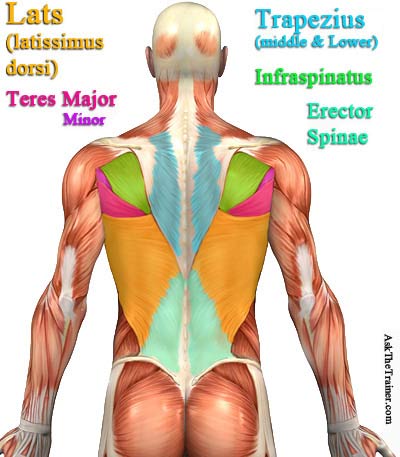
Latissimus Dorsi
The largest muscles of your back. The latissimus dorsi or “lats” are usually the muscle people are referring to when they say, “I’m doing back.”
The best back exercise would not be complete without working the lats. The lats help perform different motions when your arms and shoulders are in different positions.
A common motion performed by the lats is shoulder adduction, which is moving the upper arm back to the side of the body from an elevated position.
Another common motion of the lats is arm extension, or moving the upper arm down from an elevated position in front of the body. An example would be doggie paddle swimming.
More Important Back Muscles
Teres Major
Sometimes called the “little lat,” teres major assists with most of the motions of the lats.
Teres Minor & Infraspinatus
Both the teres minor and infraspinatus muscles are part of your rotator cuff, which helps to stabilize the shoulders. The infraspinatus helps in transverse extension along with the rear deltoids (back of shoulders). Transverse extension is the motion you perform if you lift your hands off your keyboard and mouse and pull your elbows toward shoulder level.
Middle & Lower Trapezius
The middle and lower fibers of the trapezius assist the rhomboids with scapular adduction. Scapular adduction or retraction is the motion of moving the scapula (shoulder blades) toward the spine.
The primary muscles responsible for this important motion are the rhomboids. The rhomboids are not pictured on the anatomy diagram, because they are deep (underneath) the superficial (outermost) middle and lower traps.
Erector Spinae
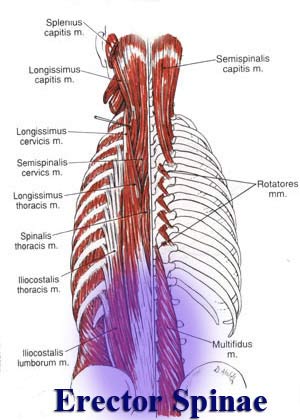
The erector spinae are your low-back extensor muscle group. Back extension is the motion you have been always told not to do when lifting heavy objects. In the anatomy diagram (above) the lumbodorsal fascia is colored. It is sheet of connective tissue covering the erector spinae.
The muscles are deep, running along the spine from the sacrum all the way to the base of the skull. Many legs exercises such as squats and deadlifts place a secondary emphasis on the erector spinae.
Therefore, if you are using a complete exercise program, you don’t have to do many exercises which isolate the lower back since the lower back is already getting a good workout. If you are looking for lower back exercises, visit our page dedicated to the best back exercise for the lower back.
The Best Back Exercises for the Upper Back can be Grouped into Two Main Categories
Rows
Rows are so named because they resemble the motion of your arms as you are rowing a boat: adduction or backward movement toward the midline of your body. Rowing exercises emphasize the middle trapezius and rhomboids more than the lats. Rows are generally performed to target the muscles in the middle and upper back.
There are many different ways to perform rows. You can use different types of resistance, different body positions and different types of grips.
Pull-Downs
Pull-downs target the lats more than rows, therefore pull-downs are the best lat exercise. Shoulder adduction is the primary motion of lat pull downs. This is the motion of bringing your elbows down to your sides from a side-elevated position.
Shoulder adduction exercises are called pull-downs because they usually involve a machine in which you pull down on a handle. The handle is attached to a cable with a weight stack on the end. If you perform pull-ups, a classic bodyweight training exercise, you’re doing essentially the the same motion as lat pull-downs, but you’re using your body weight as resistance.
Reasons to Add the Best Back Exercises to Your Workouts
The Best Back Exercises Have a Positive Effect on your Posture
The muscles in your upper-middle back perform an important role in optimal dynamic posture during daily life and during all weight training exercises. Dynamic posture is your body’s alignment while in motion. Your dynamic posture affects not only the performance of the best back exercise; it affects chest, shoulder, arm, and even leg exercises as well.
If the muscles in your upper middle back are weak and untrained, you are at risk for developing posture problems,which will negatively affect all of your weight training exercise form and increase your risk of injury. Poor weight training form will not only diminish your results, but can cause you to end up with an aesthetically imbalanced body.
The Best Back Exercises Work a Large Muscle Group
Weight training exercises for the back exercise a significant portion of your body’s total muscle mass. If you include back exercises in your full-body workout regimen, your metabolism will be elevated. A higher metabolism, along with other factors such as healthy diet, will allow you to get in tremendous shape and have a low body fat percentage.
When Should You Perform the Best Back Exercises?
If you are working out with a split routine, you may have a whole day dedicated to back exercises. The choice of whether or not to devote a whole day to back exercises depends on your goals. If you’re looking to build the back muscles, you should definitely have a specific day dedicated to the back. If you’re looking to lose weight and tone up, it’s a good idea to exercise two or more muscle groups per workout, since more muscles worked per session equates to more calories burned.
Another popular time to perform the back exercise is along with your chest, the opposing muscle group. Working opposing muscle groups during the same workout allows you to perform supersets. You can learn more about supersets in sets and reps and weight training set structure.
Videos of the Best Back Exercises
The Best Exercises for the Upper Back are Grouped into Two Categories
Best Lats Exercise
The best exercises for the lats are actually simple back exercises which have been used since weight training was first developed. You may see dozens of fancy-looking machines in your local fitness center or gym, however, most exercises do not need to be fancy to be extremely effective.
Pull-ups
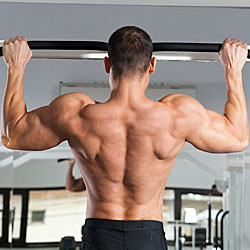
Pull-ups are the best back exercise to develop your lats and strengthen your biceps. The only downside of pull-ups is they can be very difficult for many people, requiring you to be very strong or to have a low body weight. The key to performing pull ups is to never give up. With the proper training and exercise program, you will eventually be able to do more and more.
Start: Position yourself under a pull up bar. You can have a stool or jump up to the bar. Your grip will largely determine the difficulty of the pull up.
Begin the Motion: Pull yourself up to the bar until your chin approaches or passes the bar. In order to get better at pull ups, it is best to perform full range of motion. Lower yourself slowly under complete control all the way down and repeat.
As you become more advanced, you can decrease the range of motion to focus more on different parts of the lats, truly making pull-ups one of the best back exercises and best lats exercises due to their versatility.
Modifications: Change your grip width and position to modify pull-ups. A wider grip is usually more difficult, but it will place more emphasis on your lats. The biceps usually do most of the work if you do reverse grip pull ups.
If you cannot perform the pull-up under complete control, it is actually a good idea to kip yourself up. Kipping is the motion of lifting your knees quickly to create momentum. If you do choose to kip, focus on performing the lowering phase slowly and under complete control to help build functional strength for pull-ups.
You can increase the difficulty of pull-ups by adding weight. You can do this by putting a dip belt around your waist with dumbbells or plates attached to it. You can also hold a medicine ball between your knees or put on ankle weights.
Lat Pull-Downs
There is a lat pull-down machine in every gym in the world for a reason. The lat pull-down is the next best thing for people who can’t do pull-ups yet. Some prefer lat pull-downs to pull-ups because you can lock yourself down to eliminate momentum while using more weight than just your body.
Start: Sit on a lat pull-down machine. Position the knee bar snugly on your knees and keep your feet are flat on the floor. Take a grip around the bend in the bar. The wider the grip, the less weight you should use. Before you begin the pull-down, retract your shoulders (squeeze them back together), draw in your core, and take a deep breath.
Begin the motion: Pull the bar down to the top of your chest right under your chin. There should be very little movement of your lower back. Pause for a second, making sure you feel that your lats are under tension. Exhale as you take a deep breath and return the bar back to its original position slowly and under complete control.
Modifications: The bar is pulled in front of your neck for safety. It is best for most people to do so, but there are exceptions. Some claim they get more lats work when the bar is behind the neck. It is okay to perform behind-the-neck pull-downs if you are comfortable with them and you don’t have neck or shoulder issues.
You can vary your grip to change the muscles emphasized during the lat pull down. The wider your grip, the more lats and the less arms you will use. The angle of your torso will also change the emphasis to different parts of the lats muscles.
Dumbbell Pullovers
Dumbbell pullovers are a tremendous exercise and the best back exercise if your would like to work your triceps and chest at the same time. Pullovers are different from other lats exercises because they focus on shoulder extension rather than adduction. Pullovers are a great exercise to add to back, chest or arms workouts.
Start: You can position yourself with your body either along the length of a bench or across a bench (perpendicular). Make sure the base of your neck is on the very edge of the bench so that your gaze is slightly backward.
Grab a dumbbell and position it directly on top of your chest. Grasp the dumbbell on the top part of the bell with your palms facing up and your thumbs interlocked.
Begin the motion: Lower the weight slowly behind your head. Your arms should be slightly bent. It is very important to take the deepest breath possible as you lower the weight behind your head as it will expand your chest, putting your body in the proper position to work the targeted muscles to the fullest.
When the dumbbell reaches its lowest point and you feel a stretch in your lats and triceps slowly bring the weight back up to the original position as you exhale, squeezing your chest and arms at the top of the motion.
Modifications: You can make the pullover a lats isolation exercise by keeping your arms completely straight. This will require you to use a significantly lower weight and you will lose some range of motion. You can also perform dumbbell pullovers on a stability ball.
Best Back Exercise
The best back exercises to target your upper-middle back are different types of rows. Rows are a great exercise due to their versatility. There are many more ways to perform rows in addition to the ways we’ll discuss here. Rows are basic yet highly effective exercises for your rhomboids, middle trapezius and lats.
Supine Rows
Supine refers to your body’s position when you are lying on your back. Supine rows are a bodyweight exercise, requiring no additional resistance. While pull-ups are the best back exercise for your lats, supine rows are the best back exercise for your upper-middle back.
Start: Position yourself either under a stable bench press bar or under a set of power rings. Put your feet on an elevated surface. Bring your hips up to a position parallel with the floor. Contract your glutes and draw in your core tightly.
Your body must be completely straight, and it should remain this way for the duration of the movement. Never allow your hips to drop or your lower back to arch.
Begin the motion: Pull your body up as high as you can. If you are under a bar, it is best to pull your lower chest straight up toward the bar. As you reach the top of the movement, your elbows should be close to your body.
If you are using power rings, it is best to pull your torso up slightly past the rings. As you pull, avoid flexing your wrists. Try to tell your body to lead with the elbows as if the rings were attached to your elbows and not your hands. Lower yourself under control and repeat.
Modifications: Supine rows are a great back exercise and quite challenging on their own, but if you need to increase the difficulty, you can add resistance such as a weight plate atop your chest. Another way to increase difficult is to decrease the stability of the surface you have your feet on. If you use a stability ball, these supine rows may not only be one of the best back exercises, but also a great core exercise.
Iso-lateral Dumbbell Rows
Dumbbell rows are the best back exercise because they can show you if your arms are equal in strength. They are a great functional exercise for your entire back and core. Out of all exercises for your entire body, dumbbell rows are one of the exercises for which you can use some of the heaviest weight .
Start: Position yourself with one arm and one knee on a bench. If you are going to do a right-handed row, your left knee and left arm should be on the bench. Position the foot which is on the floor about 2 feet away from the bench. Keep a slight bend in your knee and flatten your back.
Begin the motion: Pull the dumbbell up to your chest. As you pull, make sure to keep your core drawn in tightly. As the dumbbell reaches your chest, rotate your torso slightly upwards. It is very important you lower the dumbbell under control. The leg which is touching the floor is slightly bent to prevent your lower back from bearing too much pressure.
Modifications: The dumbbell row can be performed in a variety of ways. The way you have just read about is the functional way to perform them. Functional exercises mimic activities of daily living.
You can perform dumbbell rows as an isolation exercise for your lats, but they are not the best lat exercise. You do not have to perform dumbbell rows on a weight bench. You could do them from a simple bent over stance. If you do so put one foot forward and rest your opposite forearm on the knee while you perform the rows.
Single Arm Barbell Rows
Single arm barbell rows are similar to dumbbell rows, but they use a lever, which creates its own unique challenges. You can use a machine in your gym designed for this such as the t-bar row or you can rig your own lever with a regular Olympic or power barbell.
Start: Position yourself on the either side of your lever. You can be on a bench or standing in the open. If you are on a bench follow the same procedure described under dumbbell rows. If you are standing, put the leg opposite the arm you are lifting with forward. You should be slightly bent over with a neutral spine (flat back). Grab the bar close to the top.
Begin the motion: Slowly row the bar up to your chest. You can allow a slight rotation in your torso, but you want to make sure to squeeze your back. If you pull your elbow toward, your body it will help you contract your lats. Lower the weights to the original position and repeat. Remember to keep your core tightly drawn in during the whole exercise to avoid back troubles.
Modifications: These lever rows do not have many possible modifications except for the obvious: if you are not challenged by this best back exercise, simply increase the resistance by adding some weight
Must-Read Articles to Get the Most Out of the Best Back Exercise

About Michael Behnken
Mike Behnken is a personal trainer who holds multiple NASM certifications and a MS in Exercise Science. Mike loves fitness, travel, and photography among many other interests.