
- Like
- SHARE
- Digg
- Del
- Tumblr
- VKontakte
- Flattr
- Buffer
- Love This
- Save
- Odnoklassniki
- Meneame
- Blogger
- Amazon
- Yahoo Mail
- Gmail
- AOL
- Newsvine
- HackerNews
- Evernote
- MySpace
- Mail.ru
- Viadeo
- Line
- Comments
- Yummly
- SMS
- Viber
- Telegram
- JOIN
- Skype
- Facebook Messenger
- Kakao
- LiveJournal
- Yammer
- Edgar
- Fintel
- Mix
- Instapaper
- Copy Link
Best Exercises for the Calves
Knowing Basic Calf Anatomy is Very Important for Calf Exercises
There are Two Primary Calf Muscles
The best calf exercises involve both lower leg muscles. While the gastrocnemius and soleus are indeed two separate muscles, they work together to perform the same movement of plantarflexion.
Plantarflexion is the movement of pushing your toes away from your body, for example, the movement of your feet when you lift up to stand on tiptoe.
Which muscle works more to plantarflex the foot depends on the angle of the knee joint as well as the activity.
Gastrocnemius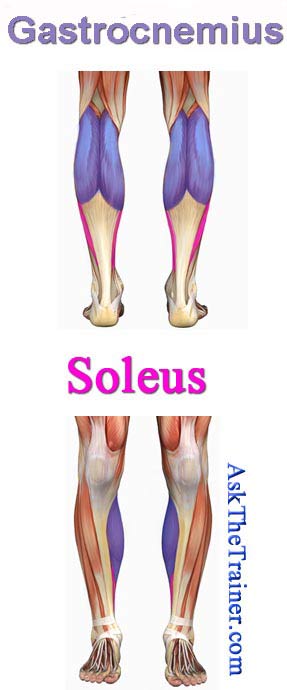
The gastrocnemius is the largest and outermost calf muscle. It is composed of a medial (inside) and lateral (outside) head. The gastrocnemius acts on the ankle joint as well as the knee joint, as both heads originate on the femur.
You will learn later why this plays a role in exercise selection. The gastrocnemius inserts into the Achilles tendon along with the other major calf muscle, the soleus.
The gastrocnemius usually contains a larger proportion of type II fast-twitch muscle fibers. Type II fast-twitch muscle fibers have an anaerobic metabolism used to create short bursts of strength and are prone to rapid fatigue.
Soleus
The soleus is the smaller muscle which originates on part of the tibia and fibula and inserts into the Achilles tendon.
The soleus consists of primarily of type I slow-twitch muscle fibers. Type I slow-twitch muscle fibers incapable of producing as much force as fast-twitch muscle fibers, but are highly resistant to fatigue.
The soleus is a postural muscle which must be contracted for long duration of time such as standing. Without the constant tension of the soleus, you would fall forward and not be able to stand.
The Anatomy and Muscle Fiber Type of Gastrocnemius and Soleus Play a Key Role in Exercise Selection
Which Exercises are Affected by Calf Anatomy?
Calf Anatomy Really Comes into Play with Gym Machines
Seated Calf Raises
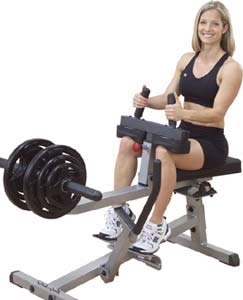
The position of the knee joint during seated calf raises does not allow the gastrocnemius to contract. The origin of the gastrocnemius plays an important role in exercise selection because it makes the gastrocnemius almost completely inactive when the legs are at 90 degrees.
Seated calf raises almost exclusively work the smaller soleus. The soleus, which is composed of primarily type I slow twitch muscle fibers, is best trained with high rep range and long time under tension. You can read about time under tension on this page dedicated to weight training volume.
Standing Calf Raises
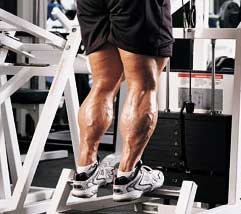
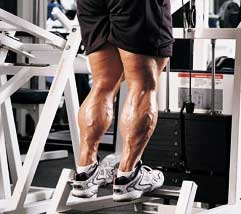
Standing calf raises work the gastrocnemius as well as the soleus. Standing calf raises can be done on a gym machine (right) or anywhere you have access to a step. Since the gastrocnemius muscles are composed primarily of type II fast twitch muscle fibers, they respond best to more intense, lower-repetition training.
An important thing to note with standing calf raises is the muscle activation during each phase of motion. During the concentric (upward) phase, the soleus is activated more than the gastrocnemius. During the eccentric (downward) phase, the gastrocnemius is activated.
If you spend more time on the downward phase with heavy resistance, you’ll get the most work out of your gastrocnemius muscle, which will help build your calves the most effectively if you choose to use gym machines.
However, calf muscle exercises via gym machines aren’t necessarily the best calf exercises. Let’s take a look at more ways to build the calves!
What are the Best Calf Exercises?
The Best Calf Exercises for You Will Depend on Your Individual Goals
Common goals for the best calf exercises are to build the calves, tone the calves, and develop explosive jumping power. A combination of different kinds of calf exercises is the best way to build the calves.
Building bigger calves is an uphill battle for many. Many experts think that calf size is largely genetic. Most people will not be able to jump like Michael Jordan with any amount of training, either.
There is Absolutely no Correlation with Calf Size and Jumping Ability
Calves are one of the most difficult difficult body part to hypertrophy (increase size) but developing explosive jumping power is relatively easily obtained with proper training.
Follow the SAID principle, Specific Adaptations for Imposed Demands, and you can see how the muscle fiber type (type II fast twitch) of the gastrocnemius, and (type I slow twitch) of the soleus will dictate which exercises are most effective. The SAID principle states that the body will adapt to specific demands placed on it. You must train in a way that aligns with your goals in order to move closer to them.
The Following Exercises are the Most Effective for Building Explosive Power and Size in the Calves
Plyometrics
Plyometrics are exercises which train the nervous system to contract more quickly and powerfully. As far as the best calf exercises go, you can think of plyometrics as jumping and hopping exercises.
Plyometric exercises are based on the principle of muscle elasticity. They help your body increase explosive power due to improved neurological response.
Due to the high content of type II muscle fibers in the gastrocnemius, plyometric exercises cause your body to increase the number of gastrocnemius muscle fibers recruited.
Plyometrics are the best calf exercises for building the muscles, as well as developing explosive strength.
Plyometric exercises are not for beginners. In order to get results from a complete plyometric exercise program and avoid injury, a certain level of training needs to be achieved beforehand.
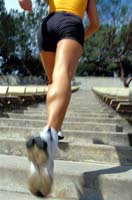
Movements with Vertical Components
Any time you move your body vertically, you have to use your calves. Gravity is your friend during the best calf exercises.
Each step you take during activities with vertical components your calf muscles, both gastrocnemius and soleus, will have to contract under greater tension.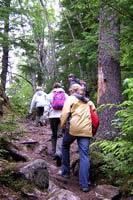
The resistance loaded on the calf muscles during hiking and climbing can equal several times your body weight.
Here are Some of the Best Vertical Activities to Build the Calves
- Hiking
- Climbing Stairs
- Running Uphill
Sports

All kinds of sports which involve sprinting and changing direction are great for building the calves. Other sports such as golf, which do not have any sprinting, are obviously not the best calf exercises.
Sprinting is a great way to build your calves, because the maximal contraction is great for recruiting the type II fast twitch muscle fibers of the gastrocnemius.
Here are Some of the Best Sports for Building the Calves
- Track & Field
- Olympic Weight Lifting
- American Football
- Soccer
- Tennis
Cycling

Especially at high pedaling speeds, bicycling is a great way to help you build your calf muscles.
Bicycling with clipless bicycle shoes which are hooked onto the pedals allows the bicyclist to use the gastrocnemius as well as the soleus for long periods of time.
Climbing hills is an especially good workout for the calves, because a bicyclist must focus on pulling the up on the pedals. Pulling up on the pedals involves hamstrings as well as the gastrocnemius and the soleus to plantarflex the ankle.
Unlike most other activities, during cycling, the gastrocnemius muscles are active for a long period of time, which can help hypertrophy the muscles if you follow a proper diet.
Are There Any Secrets to Building Bigger Calves?
Any Secret in Health & Fitness is an Unproven Theory
First of all, nothing is an absolute in fitness. Different people are built different ways and live different lifestyles. As far as the increasing the size of the calves goes, consider nature versus nurture.
Nature: Do you have the genetics for big calves? Look at your parents and siblings.
Nurture: Look at your exercise program and diet. Do you eat enough calories and perform all the different types of exercises above to help build your calves?
If you have tried everything, did it correctly, and still haven’t achieved success, a lack of flexibility and poor blood flow may be the reason why the best calf exercises have not helped you build the calves you desire.
Tight calves are one of the chronic muscle imbalances which can cause tissue, bone and joint problems. When a muscle is tight, it cannot contract properly. Blood flow is also decreased, which can lead to atrophy of the muscles.
Self-myofascial release via a foam roller increases blood flow and decreases muscle tightness, and static stretching increases flexibility and blood flow. Use a combination of SMFR and static stretching to help the calves contract properly, which will allow the calves to hypertrophy more efficiently. Check out our article on Leg Stretching Exercises to learn all kinds of stretches for the lower body.
Perform a Few Minutes of the Following Flexibility Exercises Before and After Each Calf Workout
Calves SMFR
Start: Lie on the floor and place your feet out in front of you with your calves on a foam roller. Relax your feet and do not tense up your calves.
Begin the stretch: Put one leg on top of the other.
Slowly move your calf up and down and rotate side to side to get the peroneals. The peroneal muscles run down the sides of the lower leg, and are chronically tight in many people.
Variation: If it hurts a lot, you can put both calves on the roller at the same time.
Calves Static Stretch
Start: It is best to take your shoes off. Find a wall or something sturdy to lean against.
Lean forward and put one leg back. Make sure your back toe points straight ahead.
Begin the stretch: Push your back heel all the way down to the floor. Isometrically contract every leg muscle except for your calves. Hold the stretch 30-45 seconds.
Variations: If your calves are pretty flexible to begin with, you may increase the range of motion if you place your toes on an elevated surface such as a weight plate.
Remember to perform SMFR before your static stretching before and after you perform the best calf exercises to improve their effectiveness.
Just Doing Calf Exercises is Not Enough to Be in the Best Shape
Check out the following posts for more important exercise information.
- Calf Muscle Exercises for Women to Build Strong, Sexy Calves
Find out everything you need to know to exercise your calf muscles. Here are some of the best calf exercises for women. - Click Here to Learn All About Workout Sets & Reps
Now you know the best calf exercises, but how many repetitions should you perform? How many sets? Learn how to determine how many sets and reps you should perform for every exercise, including the best calf exercises. - Key Exercises to Strengthen the Lower Body
Don’t make the mistake of just exercising your calves. If you train your legs, you will experience whole-body benefits. - Effective Exercises for the Quadriceps, Hamstrings & Glutes
Learn why it is important to strengthen your glutes and how each leg exercise may also be a great butt exercise. - Best General Exercises for Women of All Ages
Are some exercises better for women while other exercises are better for men? Learn why the answer is yes and no. - Posture Problems
You may not know you have muscle imbalances which can prevent you from making gains. - Key Tips & Exercises for the Feet and Ankles
The best foot and ankle exercises for men and women to stretch and strengthen the feet and ankles. - Five Awesome Calf Muscle Exercises
Check out these Top 5 Calf Muscle Exercises if you want impressive calves.

About Michael Behnken
Mike Behnken is a personal trainer who holds multiple NASM certifications and a MS in Exercise Science. Mike loves fitness, travel, and photography among many other interests.
Very good and interesting article :)