
- Like
- SHARE
- Digg
- Del
- Tumblr
- VKontakte
- Flattr
- Buffer
- Love This
- Save
- Odnoklassniki
- Meneame
- Blogger
- Amazon
- Yahoo Mail
- Gmail
- AOL
- Newsvine
- HackerNews
- Evernote
- MySpace
- Mail.ru
- Viadeo
- Line
- Comments
- Yummly
- SMS
- Viber
- Telegram
- JOIN
- Skype
- Facebook Messenger
- Kakao
- LiveJournal
- Yammer
- Edgar
- Fintel
- Mix
- Instapaper
- Copy Link
Lunges are One of the BEST Exercises
There are No Absolutes in the World of Health and Fitness, But…
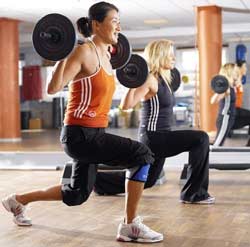
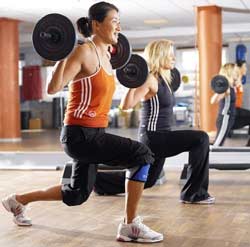
The lunge exercise is one of the very best exercises for your legs and butt. You can perform this versatile exercise just about anywhere, and you can do so with or without weights.
Lunges are also one of the best functional exercises. Functional exercises are exercises which work your body in multiple planes of motion, just like activities of daily living and athletic events.
Lunges are multi-joint movements which strengthen the muscles or your lower body while improving your stabilization and balance. Lunges are very safe and effective for almost everybody and require little or no equipment to get a great workout.
There are so many reasons to perform the lunge exercise. Lunges should be one of the staple exercises in your fitness program regardless of your goals.
Here You Will Find How to Properly Perform Lunges and How to Modify Them to Create a Time-Efficient Full-Body Workout
Jump to the Lunge Exercise Videos or continue reading to learn more.
How Do You Perform Lunges Safely and Properly?

If you read about the best leg exercises, you will already know that the knee is actually made up of three separate joints.
Instead of going through the anatomy and physiology of the joints, cartilage, ligaments, tendons, muscles and bones of the knee joint, you can look at common knee injuries to help you understand how to perform lunges properly to avoid injury.
Tibiofemoral Joint Injuries Seldom Occur in the Gym Setting
You may have heard about knee injuries such as torn ACL or MCL ligaments and damage to the meniscus, which is the cartilage of the knee.
These injuries are associated with the tibiofemoral joint, which is the articulation between your femur and the tibia (shin bone).
The tibiofemoral joint is supported by 4 ligaments and cartilage which provide joint stability. Tearing a ligament in the knee usually involves an acute trauma, such as getting tackled.
Patellofemoral Overuse Injuries Are the Most Common Knee Injuries for Non-Athletes
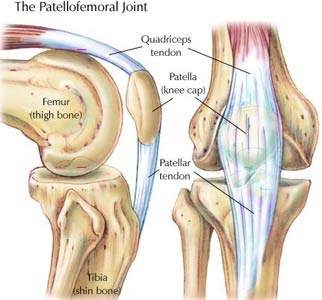
The patellofemoral joint is the articulation between your patella (knee cap) and the quadriceps tendon.
The patellofemoral joint assists the motion of leg extension and protects the knee joint. Unlike most movable joints in the body, the patella does not articulate with another bone.
Since the patella is moveable, muscle imbalances can cause the patella to move out of correct alignment. During repetitive motions such as running, walking, cycling, climbing stairs, weight training, and doing lunges, muscle imbalances can lead to the common overuse injuries affecting the patellofemoral joint.
You may have heard of different common overuse injuries to the knee called “runner’s knee” and “jumper’s knee”, which are part of patellofemoral pain syndrome.
Bad exercise form can exacerbate the development of these syndromes, and that is why maintaining proper form during the lunge exercise is so important.
Since the Lunge Exercise is a Multi-Joint Functional Exercise, it is Best Used as a Full Lower-Body Exercise
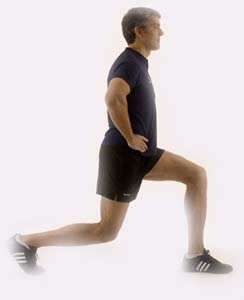
What this means is that when you perform lunges, you should use the form which will best benefit your entire lower body. If you use form which puts all your weight on your front foot, you will put most of the stress on the quadriceps.
While this way to perform lunges isolates the quadriceps, it puts excess stress on the patellofemoral joint, which can lead to the overuse injuries mentioned above. It is best to focus safer and more effective exercises for the quads if your goal is to isolate them.
To Perform the Lunge Exercise Most Effectively, Keep your Ankle Directly Below Your Mid-Knee
If you perform every variation of the lunge exercise while keeping your ankle directly below your mid-knee, you will not only work the majority of your lower body muscles evenly, you will avoid placing your knees under excessive stress.
When you perform any lunges, lunge forward and place your body weight on your front heel before weighting your toes at all. As you lower your torso toward the floor, concentrate your body weight on the back 2/3 of your foot and never your toes.
At the bottom of the movement, your back knee should be about 1 inch off of the floor with your back toe pointing straight ahead. Since the lunge exercise is a lower body exercise, you must keep your torso upright and your upper body in good posture.
Another Benefit of Proper Lunge Form is that You Stretch Your Hip Flexors, Which Allows You to Work Your Butt More Efficiently
Many Ways to Perform the Lunge Exercise
Before you try any intermediate or advanced lunges, be sure to master the correct form of the basic, beginner forms of the lunge exercise. Here are the most basic forms of the lunge exercise which involve only your lower body. You can perform them while holding dumbbells for added resistance, or just with your body weight.
Beginner Lunge Exercise
Walking Lunges
Walking lunges are the most basic form of the lunge exercise. Walking lunges are great because they are a functional exercises which helps you increase functional strength.
Functional strength will help you live daily life more efficiently while improving your balance and coordination for athletics.
Start: Stand with your shoulders in neutral posture and draw in your core.
Begin the motion: Step forward, gliding your foot along the ground until your heel touches a few feet in front of you. As your front toe lands, bend your front and rear legs, lowering down until your rear knee is about 1 inch above the floor. Your front heel should be directly below your knee. Both legs should bent at around a 90 degree angle.
From the bottom position you have many options. For the basic lunge, lift your body up at the same time you bring your hips and rear foot forward until you are in the original standing position.
Push Back Lunges
Push back lunges are another great functional exercise. If performed properly, they can help you develop explosive power in your lower extremities, as well as tone and build your hamstrings, quadriceps and glutes.
Start: Make you are on a non-slick surface. Stand upright with your core tight and your shoulders in neutral posture.
If you have weights, you can either hold them hanging down at your sides or from a high-hang position at shoulder level.
Regardless of where you hold the weights, make sure they remain close as possible to your center of gravity, or the middle of your body.
Begin the motion: Lunge forward, gliding your foot along the ground, landing on your heel first before your toes.
Lower your torso straight down with little forward motion once your front heel hits. Your back knee should stop about 1 inch above the ground.
Pause here for a second, then explosively push yourself back to the original position and alternate legs. Do not allow the weights to swing or your upper body to lean forward or back for the duration of this lunge exercise.
Intermediate Lunge Exercise
Front Foot Elevated – Stationary Lunges / Split Squats
Elevated stationary lunges are also called split squats. They are a great multi-joint legs and butt exercise which can be effective with just your body weight.
Start: Put your front foot up onto an elevated surface. Position your knee so the middle of the knee joint is right on top of your ankle. Hold a pair of dumbbells in the low- or high-hang position.
Scoot your rear foot backward until you can create around a 90 degree angle with your back leg to match your front leg. The ball of your back foot should be on the floor. Draw in your core and keep your shoulders retracted.
Begin the motion: Slowly lower yourself straight down toward the floor. Your upper body should remain upright with a neutral back.
Do not let your knee move forward at all if you are trying to work your butt. When your back knee approaches the floor, pause for a second and lunge back up to the top position.
Modifications: You can increase the difficulty of these legs and butt exercises if you use an controlled unstable surface for your front foot. A BOSU ball would be a good choice.
Rear Foot Elevated – Stationary Lunges / Bulgarian Split Squats
Bulgarian split squats are another version of the lunge exercise. The elevation of your rear foot increases the challenge, as you’ll be balancing on your front foot.
Start: You can use a weight bench or any elevated stable surface. Put your rear foot up onto the surface. Whatever you choose to rest your rear foot on, make sure it allows your toes to point in the same direction as your knees.
Hop your front foot forward until the middle of your knee is directly above of your ankle. This requires pretty good balance. You can hold onto something if your balance is poor.
Begin the motion: Keep your upper body as upright as possible as you lower down toward the floor. Don’t allow any forward motion in the front thigh.
Modifications: If you decide to perform these legs and butt exercises while you hold on to something, you should use extra resistance. If you set up close to a squat rack you can position the bar to where you can hold on for balance. If you decide to hold on, you can hold a dumbbell in the same hand as the forward leg.
Lunges with a Twist
Lunges with a twist are an exercise which will allow you to gauge your progress. If you are able to properly perform lunges with twist, you are most likely ready to progress to the most difficult advanced lunges.
If you haven’t mastered the lunges with twist you should practice until you master them before you move on to the advanced lunges. The previous lunges have all been lower body only with no upper body movement. Lunges with a twist work your lower body as well as your core and obliques.
Start: You can either perform these walking provided you have enough free floor space or stationary if space is limited.
You can perform lunges with a twist with a weight such as a medicine ball or just with your outstretched hands. Stand up tall with your core drawn in and your shoulders in neutral alignment.
Begin the motion: Lunge one foot forward and land with your heel or the back 2/3 of your foot first. Lunge far enough forward that your knee is directly above your ankle and your front and back legs are both close to a 90 degree angle.
From the bottom position with your back knee about an inch off of the floor, extend your arms with the medicine ball. Keep your core tight and rotate your upper body and the medicine ball over the front leg as far as you can while you maintain your drawn in core.
Modifications: You can perform multiple stationary lunges for each lunge or multiple twists each time you lunge for a more intense workout. This is a good exercise to use at the beginning, middle, or end of your medicine ball workouts.
Advanced Lunge Exercise
Advanced lunges are all about adding multiple exercises and multi-joint motions to your lunges. This will allow you to work a very large amount of your body mass, which boosts your metabolism and burns more calories. This is great for maximizing your time in the gym, but requires mastery of the basic and intermediate versions of the lunge exercise.
Lunges with Lateral Raises
Lunges with lateral raises allow you to work your shoulders while you perform the best lower body exercise, which as you now know, is the lunge exercise.
Just a reminder: if you are trying to lose weight or tone up, it is best to use mostly multi-joint exercises in your workout plan while avoiding isolation exercises such as lateral raises. This is a great way to get in some lateral raises while you perform a lunge, which will work a large muscle group at the same time.
Start: Stand up with a pair of dumbbells held at your sides. Your upright upper body posture should remain constant for the duration of your lunges. Draw in your core as you take a deep breath.
Begin the motion: Lunge one foot forward, gliding it along a couple inches above the floor. Land on your heel and set your toes down while keeping the majority of your weight on your heel.
Lower your body toward the ground. As your back knee approaches the floor, pause with your torso upright in the middle of both legs which should be at congruent 90 degree angles. Perform a lateral raise and lower your arms as you lunge back up to the original position.
Modifications: You can also perform front raises separately or along with your lateral raises. You can perform multiple stationary lunges in between each step to increase the difficulty as well.
Lunges with Biceps Curls and Shoulder Press
Lunges with biceps curls and shoulder press are one of the most advanced forms of the lunge exercise.
In this lunge exercise, you will perform a full lower-body dynamic contraction with an isolation movement for your biceps, and then from a balanced position a multi-joint movement for your deltoids and triceps.
Start: Get focused and stand up tall with a pair of dumbbells at your side. Keep your core tight and your upper body should be upright for the duration of this entire complex movement.
Begin the motion: Lunge forward as usual putting your heel down first and making sure your upper body is in the center of gravity. Perform a biceps curl when your body is completely stable at the bottom of the lunge. After you perform your curl keep the dumbbells at shoulder level in a high-hang position.
Lunge back up to a balance and perform a shoulder press. Try to keep your balance and let the weights come all the way down to your sides at the original position and repeat.
Modifications: You can add a stationary lunge in between each step to make this exercise more difficult. You can also add a biceps curl during each stationary lunge and multiple shoulder presses during each balance. There are many different possibilities for modifying this advanced lunge exercise, limited only by your imagination. Just remember that safety and science should always come first. Once you have the basics mastered, feel free to improvise and develop your own workouts.
Learn More About Building the Legs and Complement the Lunge Exercise to Improve your Physique
- Best Exercise Information: Resistance Training Articles
Click on any body part to find the safest and most efficient resistance training exercises to work that body part, complete with Exercise Videos. - Best Leg Exercises
Even if you get bored with the lunge exercise, you can find many more effective leg exercises to work your legs and glutes. - Legs and Butt Exercises
Are you skinny and want to put on some muscle in your legs and butt? Or do you want more multi-joint exercises to build out your fat loss program? Lunges are great, but there are more exercises than you may think.

About Michael Behnken
Mike Behnken is a personal trainer who holds multiple NASM certifications and a MS in Exercise Science. Mike loves fitness, travel, and photography among many other interests.